01 · SCOPE OF SUPPORT
What does this procedure involve?
Marriage, education, company formation, inheritance and powers of attorney may involve using foreign documents. A readable document accompanied by a translation is not necessarily sufficient for acceptance. The original, the issuing authority, signature and authentication details, and the receiving institution’s requirements are checked together.
An apostille does not confirm the truth of every statement in a document or establish that the document is sufficient for every transaction. It authenticates official features such as the signature, the capacity of the signatory and the seal. The legal content and suitability for the application must be assessed separately.
Document and country review
Identifying authentication requirements from the document’s origin, the destination country and the receiving institution.
Planning document procurement
Determining whether an original, copy or newly issued document is needed and the authority from which it should be obtained.
Coordinating authentication and translation
Following the required steps in the appropriate order and form with the relevant authorities and professionals.
Checking suitability for the application
Assessing whether names, dates, authority to act, translations and attachments can be used together for the intended purpose.
02 · THE PROCEDURE
From preparation to follow-up, step by step
Identify the intended use
Clarify the country and procedure for which the document is required.
Examine the nature of the document
Check the issuing authority, document type, date, signature and attachments.
Identify the authentication route
Consider an apostille or another route in light of the relevant treaty relationship, any specific exemption and institutional requirements.
Complete translations and certifications
Coordinate the steps according to the language and form of translation accepted by the receiving authority.
Prepare the document package for delivery and use
Organise the document, authentication and translation together, and plan any dispatch and delivery arrangements.
03 · DOCUMENT PREPARATION
Documents and preparation checklist
0 / 7 document categories prepared
Use this as a preparation checklist. The authority or your circumstances may require additional documents. Selections are cleared when you leave the page.
What does an apostille authenticate?
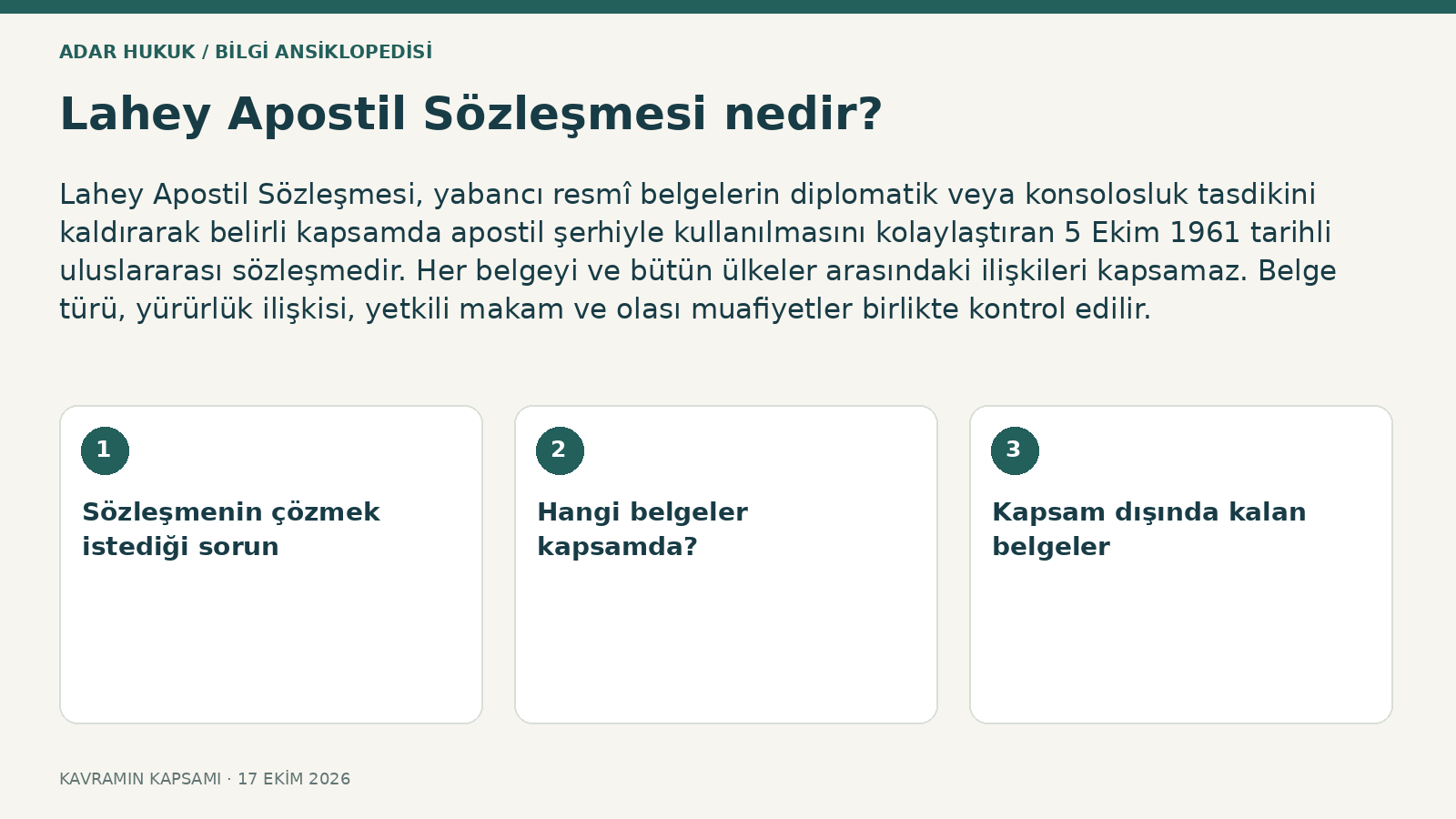
Under the applicable Convention, an apostille authenticates formal features of a public document, such as its signature and seal. It does not establish that the underlying facts are true or guarantee that the right sought through the document will be granted.
For example, an apostilled power of attorney does not confer a power absent from its wording. Whether the document includes the authority required for the intended transaction is a separate legal question from authentication by a notary or another issuing authority.
Translation and consular legalisation
A translation makes a document understandable in another language. The translator, certification and order of steps accepted depend on the receiving authority’s rules. A translation prepared in Turkey should not be assumed to be accepted in the same way by every foreign institution.
Other authentication chains may be needed where the apostille route does not apply to the document or the relationship between the countries. Treaty-based exemptions may also apply to certain documents. The country, document and intended use are therefore considered together before work begins.
Electronic apostilles and the age of a document
An electronic apostille is also an official form of authentication within the relevant Convention framework. Its electronic verification facility and the appropriate method of submitting it to the receiving institution should be preserved. The conditions for using a printout may differ from those for the electronic original.
An apostille does not automatically satisfy a receiving institution’s requirement for an up-to-date document. The institution may request a recently issued civil-status, registry or other record. If the information has changed, a new document or supplementary record may be needed.
POINTS TO WATCH
Common mistakes and important distinctions
Treating an apostille as approval of the content
Authentication does not establish that the authority or statement in the document is sufficient for the intended procedure.
Completing steps in the wrong order
The order of translation and authentication may vary by receiving institution, so the route should be identified first.
Sending an incomplete document
An assessment made without attachments or the authentication page can lead to the wrong conclusion.
Using the same route for every country
The Convention’s application and document exceptions should be examined in the context of the countries concerned.
PLANNING THE WORK
Legal fees, expenses and timing
How are fees and expenses determined?
The total expense depends on the document type and number, issuing country, target language and required authentication steps. Document procurement, translation, notarial or consular expenses and delivery are considered separately from legal services. Any charge imposed by an authentication authority is checked against its official tariff; the same fee is not assumed for every apostille procedure. At the initial review, the document in its existing form is examined and the necessary steps are explained. The receiving institution’s requirements guide the process to avoid unnecessary repeat authentication or translation. International delivery costs and any additional records that may be required are identified separately to the extent known at the outset.
What can affect the timetable?
The timetable consists of obtaining the document, processing by the competent authority, translation and delivery. Obtaining a new document abroad or authentication by several authorities may extend the process. The ability to translate a document promptly does not mean that the entire application file can be ready on the same day. Where the final date for use is known, the steps are planned backwards from that date. Further requirements from the receiving institution may need additional time. A fixed delivery date is not promised before the file has been reviewed.
HYPOTHETICAL EXAMPLE
Illustrative situation: using a foreign power of attorney in Turkey
Suppose a person living abroad has a power of attorney prepared before a foreign notary for a property transaction in Turkey. Even if it carries an apostille, the wording must be examined for the powers needed, consistency of identity details and any Turkish translation requirement. The scope may be important for transferring the property, receiving the price or carrying out other specific acts. All pages and the authentication attachment are reviewed first, followed by the receiving institution’s acceptance conditions. If something is missing, the need for a new document is assessed. Translation and delivery are planned after that assessment. This hypothetical example does not mean that every foreign power of attorney will be accepted in the same form or that an apostille remedies all defects in its content.
QUESTIONS AND ANSWERS
Frequently asked questions
Does a lawyer issue an apostille?
No. An apostille is issued by the competent authority designated by the relevant country. A lawyer can review the document’s legal content and assist with the procedure.
Does an apostilled document still need a translation?
A translation may be necessary depending on the language accepted by the receiving institution and the type of document. An apostille does not replace a translation.
Is an apostille sufficient for every country?
The treaty relationship, scope of the document and any specific exemptions must be considered. Another authentication route may be needed.
Can the entire procedure be completed using only a photograph?
A photograph helps with preliminary review. The need for an original or a properly certified copy is determined for the particular procedure.
Is an electronic apostille invalid?
Electronic form alone does not make an apostille invalid. Official verification and the appropriate method of presentation should be preserved.
READ THE ORIGINAL SOURCES
Official sources and application information
- Ministry of Foreign Affairs — Authentication questions and answers ↗
The relationship between apostilles and Ministry authentication procedures.
- HCCH — Text of the Apostille Convention ↗
The scope of apostilles, their authentication function and competent authorities.
- HCCH — Apostille information centre ↗
Contracting parties, competent authorities and information about electronic apostilles.
This English edition was prepared on 10 November 2026 from the Turkish guide dated 9 November 2026, retaining its official sources. Editorial dates are not legislation commencement dates or a record of individual lawyer approval. Some sources are in Turkish. Current authority requirements and the circumstances of your matter must be considered together. Editorial policy (Turkish)