01 · SCOPE OF SUPPORT
What does this procedure involve?
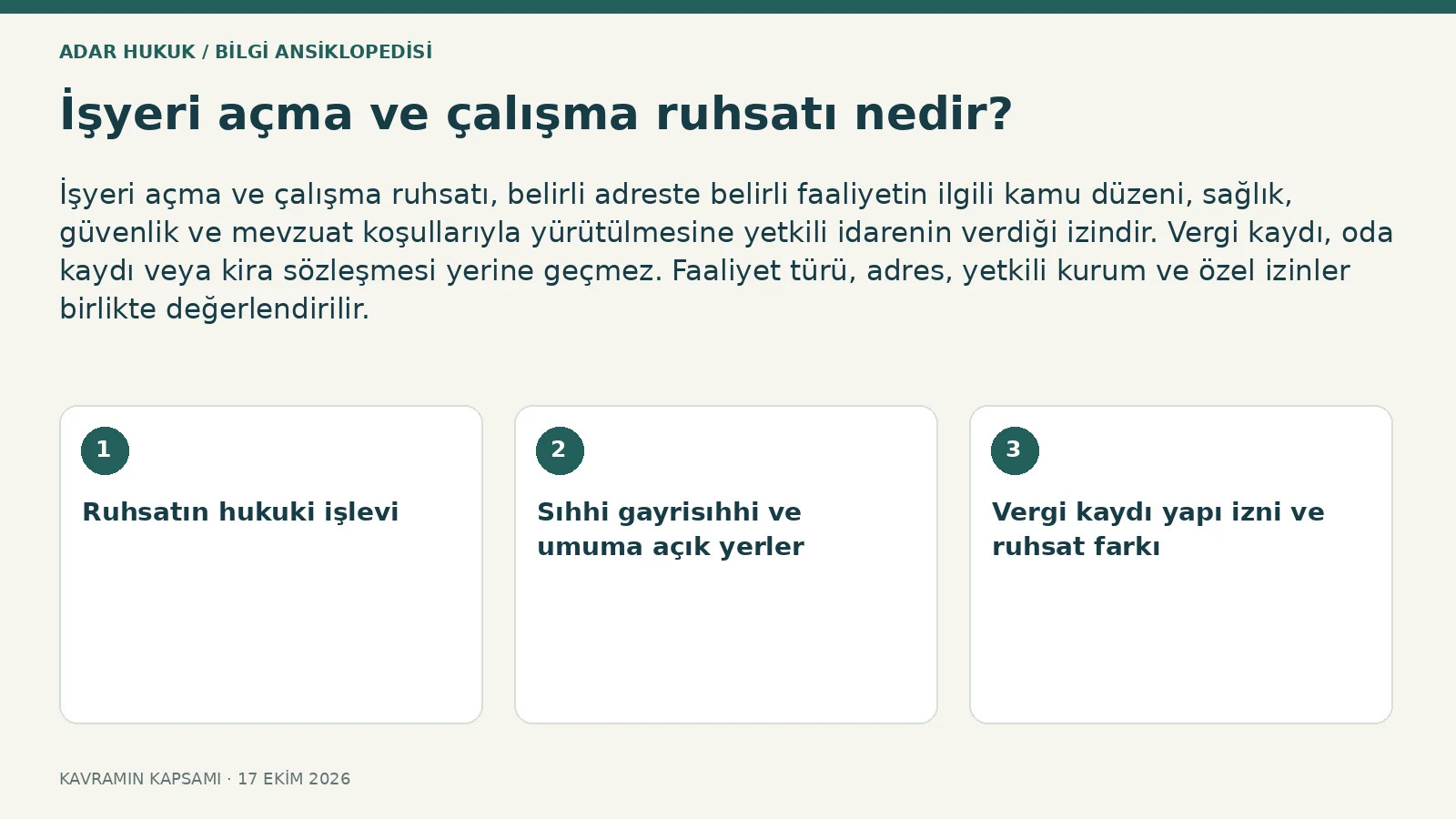
Premises that appear commercially attractive may not be legally suitable for the intended business. Assessing the use, building documents, management plan and licence type before signing a lease or spending on alterations can help reduce later disputes.
Licensing procedures vary with the activity and location. The competent authority may be a municipality, an organised industrial zone or another body. Sector-specific permits may also be required. The application file is prepared after these distinctions have been made; another business’s document list should not simply be copied.
Legal review before licensing
Identify the application route by considering the activity, location and legal right to use the premises together.
Lease and transfer documents
Review contractual provisions concerning licensing and operating conditions when premises are rented or a business is transferred.
Application and missing-document follow-up
Prepare the legal and administrative documents required by the competent authority and coordinate the provision of technical materials.
Assessment of refusal or delay
Review the authority’s response or failure to act in the context of the file and explain the relevant administrative and legal options.
02 · THE PROCEDURE
From preparation to follow-up, step by step
Define the activity
Identify what will actually take place at the premises, its capacity and the way the space will be used.
Review the premises and competent authority
Clarify the address, building and use information, and the institution responsible for the application.
Separate the document groups
List the applicant’s documents, property records and technical reports separately.
Submit the application
Apply with proper authorisation and retain submission and registration records.
Follow the assessment and result
Monitor deficiency requests, inspections and additional permits, then check the scope of the licence issued.
03 · DOCUMENT PREPARATION
Documents and preparation checklist
0 / 7 document categories prepared
Use this as a preparation checklist. The authority or your circumstances may require additional documents. Selections are cleared when you leave the page.
Assessing the property before applying for a licence
Describing premises as a shop in the lease does not establish that they are suitable for every activity. The registered property type, building use, activity classification and any required owners’ resolutions are examined according to the file. Planning and technical conditions may require specialist advice.
The lease can address what happens if a licence cannot be obtained, permissions for alterations and the allocation of expenses. Such a clause does not oblige the authority to issue a licence; it clarifies responsibility between the contracting parties.
Premises licences and sector-specific permits
Businesses operating in food, tourism, healthcare, education or other regulated fields may require permits and registrations from different institutions. A document issued by one authority does not automatically provide permission within another authority’s remit.
The file should therefore identify each permit, the authority to which the application is made and the person responsible. Preparing technical reports is not presented as a legal service. Legal application support may include using those reports in the relevant procedure.
Transfers, changes of activity and outcome notices
How a licence issued to the previous operator is treated for the new operator depends on the nature of the transfer and any change of activity. It should not be assumed that operations can continue simply with a photocopy of the old licence.
If an application is refused, the written reasons and notification date matter. In the event of delay, available administrative options are assessed under the current rules and the status of the application. Procedural follow-up and bringing court proceedings require separate scopes and deadline management.
POINTS TO WATCH
Common mistakes and important distinctions
Investing before reviewing the premises
The main licensing conditions should be examined before committing to rent, decoration and equipment expenses.
Treating tax registration as a licence
Tax or trade registry registration does not replace a business premises and operating licence.
Trying to resolve technical deficiencies with an application letter
Required physical or technical conditions are not fulfilled merely by changing the wording of the application.
Relying on an oral response
Written notifications and application records should be followed to establish why a file is pending.
PLANNING THE WORK
Legal fees, expenses and timing
How are fees and expenses determined?
Costs vary according to the activity and the permits required. Official charges, technical project or report fees, translation and notary expenses, and legal services are separate items. At the outset, it is established whether the work involves only following the licence application, reviewing the lease or assessing a refusal. Alteration and physical conformity costs are not assumed to be included in the procedural service fee. An expense list is prepared using the competent authority’s current tariff and the documents actually required. If an additional activity or change of address arises, its effect on scope and cost is explained separately.
What can affect the timetable?
The time required depends on the licence type, completeness of the documents, technical conditions and the competent authority’s assessment. The period envisaged for the application is different from the time required to remedy deficiencies or obtain another institution’s opinion. The business opening date should not be fixed before the file is reviewed. Preparation requirements and dependencies between permits are identified first, followed by a plan for submission, assessment and outcome. If there is a refusal or inspection notice, the applicable deadlines for further action are considered separately.
HYPOTHETICAL EXAMPLE
Example scenario: Opening a new café
Suppose an entrepreneur is considering renting a shop to open a café in Istanbul. The premises were previously used for a different activity, and the entrepreneur assumes the previous licence will be sufficient. Legal preparation examines the new activity, the property’s use information and the contractual terms. Documents requested by the municipality are separated from reports to be prepared by technical specialists. Responsibility for alterations and the permit process is considered in the lease. Once the application file is complete, further requests and the written outcome are followed. This hypothetical example does not establish that a particular shop will obtain a licence or open within a specified period. It shows why the investment decision and the licensing process should be planned together.
QUESTIONS AND ANSWERS
Frequently asked questions
Is establishing a company enough to open business premises?
No. The premises licence required for the activity and any special permits must be assessed separately.
Can I use the previous business’s licence?
The procedure depends on the operator, activity and transfer conditions. The old document does not automatically establish the new position.
Does the lawyer prepare technical reports?
No. Technical reports and plans are prepared by authorised specialists. The lawyer provides legal review and administrative follow-up.
Can I obtain help only with my existing municipal application?
A limited scope for procedural follow-up can be agreed after reviewing the current application and authorisation.
What happens if my application is refused?
The written reasons, notification date and circumstances of the file are reviewed to assess administrative applications or court proceedings.
READ THE ORIGINAL SOURCES
Official sources and application information
- Ministry of Justice — Regulation on Business Premises and Operating Licences ↗
Provisions on licensing, competent authorities and applications.
- Invest in Türkiye — Business Premises and Operating Licence Process ↗
Official process diagram showing application stages by licence type.
This English edition was prepared on 10 November 2026 from the Turkish guide dated 9 November 2026, retaining its official sources. Editorial dates are not legislation commencement dates or a record of individual lawyer approval. Some sources are in Turkish. Current authority requirements and the circumstances of your matter must be considered together. Editorial policy (Turkish)